Canicus in Athens: Day 9 (18 September 2013)

Today I thought I would check out the Odeon at the base of the Acropolis. It turns out that it is open only for performances. And what, you might ask, is an Odeon. It is somewhat like an amphitheater although smaller and covered. It was used for musical performances. I saw the first century Roman  Odeon in Lyon, France, last year. So not being able to get it wasn’t all that big a disappointment.

So I walked a bit further and took in the Theater of Dionysus, which is very much what you think of when you think of a Greek theater.  It is a semicircular affair. There is a flat orchestra where the action mostly occurred surrounded by banked seating. The upper levels are missing, but it apparent where they were. The VIP seating is stone chairs in the first, lowest row next to the orchestra. In the center of this row are what we might call ‘box seats’ for the VVIPs. The most important of these seats was reserved for the god Dionysus himself. There was a temple of Dionysus behind the proscenion and scene. An image of the god would be carried from the temple to his reserved seat before the play began. As seems to always be the case with these ruins, the proscenion and scene are pretty much gone except for the foundations. Some of the play action would have occurred on these structures and they might provide scenery or even mechanisms such as those used for a deus ex machina intervention of a god or a floating Socrates in Aristophanes’ The Clouds. This theater would have seen ‘World Premieres of playwrights like Sophocles and Euripides.

After that I encountered a man playing a concert cimbalom. I took about a minutes worth of video of him. I succeeded in uploading it to YouTube. (http://youtu.be/l-eJf0f10mk) Uploading video is painful. This took nearly two hours to upload!

I enjoyed a frappe with cinnamon ice cream near the Acropolis Museum. I then took a ‘train ride’ on one of those silly park motor trains. It wandered around parts of Athens I had seen before. But it went through some very narrow streets where you could buy nearly anything. There were shops selling everything you might need to equip a Greek Orthodox Church including vestments. There were jewelry shops, Rug shops. Soccer uniform shops. Musical instrument shops. (I might have bought one if I had a way to take it home with me. Etc., etc., etc. The train went through the flea market, past the Tower of the Winds and the old Roman Forum – where you could even buy a red Che Guevara flag.

Before I left some folks expressed fears that I might encounter riots and demonstrations because of the economic crises. I told them I wasn’t worried because those would not be in the tourist areas – which has been almost completely true. There are a few painted announcements of a hunger strike around the Acropolis. But no demonstrations. Until today. This train got delayed at the square in front of the Parliament because there was a big demonstration going on. There were hundreds, maybe thousands, of men and women marching around the square. Many wore orange tee shirts (no this wasn’t an extension of the Texas women’s demonstrations against the Texas legislature’s restrictive abortion measures) and flags. They also carried big signs which, as they were in Greek, I couldn’t decipher. There were also a few blue flags and shirts and even few red flags and shirt. There was also singing. The demonstration was entirely orderly; there was no rioting or the like. I did see some EMS type personnel on the fringes, but no particular presence of police or military. I asked the lady who sold tickets for the train what the demonstration was about – she said ‘jobs, money, the economy.’ I asked her if it was in support of the current Greek government (which is attempting to ease the austerity measures) and she said yes.

Tomorrow I’ll pack and transfer to the airport hotel in readiness to fly to Frankfort at (ugh) 6:15 AM Friday morning. I figure it is better to sleep an hour later instead of taking a taxi from this hotel at 3 AM to do the check in at 4:15. I’m wondering though. In past years when I have had these ungodly red eye flights out of Paris and Rome there was no one working at the supposed check in time. I’ve always ended up waiting for the shift to come on duty.

 Canicus Modius

Canicus in Attica: Day 8 (17 September 2013)

Yesterday was a long day, so I decided to sleep in today and then book a bus tour Wednesday to the Peloponnese – Corinth, Mycenae, Argos, Nauplia and Epidaurus. The tour book says a ‘Full Day.’ Indeed! Well, it turns out that the company is taking a day off tomorrow. No tours. So I booked a half day tour in the afternoon to Sounion. The bus trip is along the coast of the Sardonic Gulf and through some spectacular hills/mountains.

The real target of the tour was the Temple of Poseidon that overlooks the Aegean Sea. Poseidon is one of two important gods for the Athenians (Athena being the other). As god of the seas Poseidon was important to a city engaged in international commerce and at times international power politics in the Mediterranean world. Myth says that sometime in the misty days of prehistory, a contest was waged between Poseidon and Athena as to which would be the god of the city. Each god gave a gift – Poseidon gave salt; Athena an olive tree. Athena was declared the winner. For centuries Athens olive groves were the secret of her economic power. That olive oil was prized – and still is, for that matter. I mentioned the early Athenian coin in an earlier blog. In addition to Athena and her owl, the coins of Athens bore an olive branch. (It also has a crescent moon, which is another story.)

I returned to a supper of kebabs near the Acropolis museum. And some excitement. The restaurant has a bunch of shrubs in front of it. I happened to notice a guy with a big water bottle pouring water into the pot that held a plant. Next thing I know three big waiters take off after the guy and chase him across the street where they really gave him a beating. At first I wondered – is it so bad to water the plants? Then one of the waitresses retrieved the bottle from the shrubbery. Moral: Don’t litter in Greek restaurant shrubs. They really need signs: DON’T MESS WITH ΕΛΛΑΣ.

Today I did get some of the picture journals done for last week. Maybe I can get yesterday’s and todays done tomorrow. Since I can’t do a tour, I’ll probably spend part of the day seeing what I missed around the Acropolis. I’ll need to also figure out how I’m going to get stuff in suitcase, backpack and camera case. There is a lot more stuff than came with me.

Canicus Modius


Canicus in the Greek Islands: Day 7 (16 September 2013)

Up early to walk to another hotel where I caught the bus to Piraeus – the historic port of Athens. I transferred there to a cruise ship to do a bit of island hoping. It was pleasant on the ship which has three levels. The lowest level was the dining room, the middle level tables and chairs and the top level open (although part of it had a canvass covering for shade).

At the bus stop I met a lady and her daughter waiting for the bus. She had studied in Athens and was a major in art history. So she knew a lot about Athens and Greece and was introducing her daughter. We spent some time together on the ship and were joined by a lady from Nigeria.

There was entertainment on the top deck that got a bit crazy. It started out with popular Greek music and dances, but eventually evolved into things like ‘Hava Nagila’ and ended up with things like ‘Oh when the saint go marching in.’

The first port of call was Hydra, which seemed mostly to be tourist shops. I had been instructed to get a Greek fisherman’s cap in Greece. I had spotted on the first night I was in Athens but decided there was plenty of time to buy one. I never saw another in Athens. So I started searching the shops in Hydra and eventually did find one. It has ‘Authentic Greek Fisherman’s Cap Mad in Greece.’ So I guess that’s official. I also bought a fancy letter opener and a tiny, tiny chess set. They had nicer chess sets, but they were also bigger.

The second stop was Poros. More tourist shops. I did break down and buy a tee shirt and a couple of bookmarks. I keep remembering that this stuff has to fit in my suit case.

After Poros we had ‘lunch’ on the cruise ship. It was a buffet and my problem is that at buffets I always eat too much. And as a consequence, I was very sleepy all afternoon.

The final stop was Aegina. Tourist shops seem to have been replaced with sidewalk cafes. I wasn’t all that hungry but I did go for a scoop of ice cream. Somehow Greek ice cream isn’t as good as Roman gelato or Texas’ Blue Bell. The day had started out sunny, but it clouded up in the afternoon and looked like it might rain. Aegina seems to be the place to by fruit, vegetables and pistachio nuts. I already had too much stuff, and bringing agricultural products into the US causes problems at customs. But the ship’s crew were all carrying bags of fruits, vegetables and nuts.

Speaking of pistachio nuts, all the nutrition experts say they are good for you. But every time I look at them in the store they have more than the recommended daily allowance of salt for normal folks and way, way too much for someone the doctors want to have a low salt diet.

While I was waiting for the cruise ship to sail from Piraeus I finished yesterday’s travelogue; and while I was waiting for it to sail from Aegina I did most of today’s log. So in a few minutes they will be available on this blog.


Canicus in Athens: Day 6 (15 September 2013)


Today the primary goal was to see the changing of the guard at the Tomb of the Unknown Soldier. This takes place in front of the parliament building. They change guard hourly, but the fancy ceremony occurs only at 11 AM on Sunday morning.

I arrived just as the 10 AM change was finishing. That is followed by a period when tourists can pose for pictures beside the two duty guards. Before 11 the police started moving everyone to one side of the plaza. Fortunately, I was on the wrong side of the plaza. Which meant that I ended up in front of the crowd to observe the change.

This ceremony is led by a band down the main street in front of the plaza. It is followed by three platoons (?) of costumed soldiers. They enter the plaza and stand at one side while the new guards march across the plaza and relieve the duty guards. The band plays the Greek national anthem – or at least I assume that is what it was. Then the band strikes up another march and they march back the way they came.

The costumes worn by the guards and the troops (except for the band) are difficult to describe. There is a tunic similar to those worn by ancient Greeks. There is a sort of overlay cape that hangs down to about the waist. They wear ‘tights’ covering their legs, with a black pompom at the knees. There are also pompoms on the shoes. The shoes have cleats which make a scraping noise when the foot slides on the pavement and makes a loud click when they put the foot down. The uniform is topped with a sort of red ‘beanie’ to which a black tassle which hangs to the waist is attached. They are armed with rifles and bayonets attached.

I wasted the rest of the day attempting to edit the video which is still too long to upload and needs some cutting to make it useful. I am behind on the pictures – that may have to wait until I get back to Dallas and get caught up.

I’ve booked a one day, three island cruise for Monday. I hope to visit Delphi one day and Corinth and Mycenae another day. Thursday will be packing day and transfer to the airport hotel. My plane leaves for Frankfort at 6:15 AM – which I take it means I will need to check in at 4:15 AM. By staying in the airport hotel, I should be able to sleep until 3:15 instead of 2:15 if I stayed in my original hotel.

Canicus Modius.

Canicus in Athens: Day 5 (14 September 2013)

Well, I survived another Friday the 13th.  Today I took off in a clockwise direction around the base of the Acropolis. This took me to the area of the Temple of Hephaestus. Hephaestus was the god of blacksmiths, volcanoes, craftsmen and artisans – the Roman equivalent is Vulcan. Because ancient Athens was home to a large number of craftsmen and artisans he was an important Athenian god; his temple reflects that importance. It is also one the better preserved Greek temples. The exterior columns are still in place as well as the walls of the interior cella.

The temple overlooks the ancient Greek agora of Athens. When I say, ‘over looks,’ I mean over looks. The ticket entrance and exit to the temple also serves as the entrance and exit to the agora. I would estimate that the agora is some 300 feet lower than the temple. Going down into the agora probably would not be a problem for me – however, climbing out of it would. Athens, I am finding, is a very hilly place – much more so than Rome. Incidentally, the top of the Acropolis is yet another 600 feet or so above the level of the temple.

I continued my clockwise walk, but actually drifted far from the loop that encircles the Acropolis. My drift was partly intentional because I figured that I would end up in the Roman agora. An agora is a central market and meeting place rather like the Forum in Rome was. In the Greek agora, democracy was born (and fell to demagogues). This was where Pericles, Themistocles, Demosthenes and others made their speeches. It was where Socrates was tried. It is where elections were held. Of course, the Roman agora was a different political world ruled by Roman emperors from Augustus onward. There are some pillars remaining of this forum, but most of it is the remains of building foundations.

Nearby is another interesting structure – the octagonal Tower of the Winds. Each side represents one of the eight winds. On the top there was a weather vane, now gone. This was important to a city engaged in sea going trade and even, for a time, empire. On the sides of the building there were rods extending out that served as a sundial, so Athenians could tell what time of day it was. Inside the tower there was a water clock to tell time when the sun was not shining. The water clock is gone, the faces of the sundials are obscured or gone, but at least one of the rods still extends from the tower.

I tried circling back but ended up in Monastiraki area. This is maybe the world’s largest flea market and garage sale. If you are in need of junk, you can buy junk here. I saw several ancient Singer sewing machines, a washer/dryer, thousands of CDs, thousands of wall warts, arts, crafts, tools, and just plain junk.

I also encountered the Greek Orthodox Metropolitan Cathedral. It is tiny, tiny. I doubt you could get 100 people in there; maybe not even 50. And it is insufferably hot even when not packed.

About that time I encountered a faux train that runs around the area and took it back to the entrance to the Acropolis. That is a few hundred meters from my hotel. On the way I stopped at a store to buy some souvenirs. One of the items — the most expensive – was the obligatory replica of Phidias’ Athena Parthenos (Athena the Virgin), the enormous statue of Athena that was in the Parthenon. The original is long gone, but we know what it looked like because ancient tourists also bought these replicas. Mine is, of course, much smaller than the original – as were those replicas purchased by tourists over 2,000 years ago. I also acquired a Greek vase – another museum reproduction. And, of course, a few owls. Athena (and Athens) are associated with an owl. Homer calls her ‘owl eyed Athena.’ And in the Perseus story, Zeus tells Athena to send her owl to help Perseus on his quest to find a way to slay the Kraken. She fudges. She has Hephaestus (remember Hephaestus? If not go back to the beginning of this blog and read it again) make a mechanical owl to give Perseus.

Athenian Quadrachma
Athenian Quadrachma

The owl was also featured on ancient Greek coins one of which I have in my coin collection. It is a fine example. I bought it for $25 when I was in college. It is worth around $1,500 today.

I am running a bit late getting photos up on the website. I finally broke the National Archeological Museum pictures into two separate slide shows. You can access them from canicusmodius.com. Look for the Journals on the left, click on the first week. That will bring up a table of links that have been posted so far. I am not posting much in the way of pictures to Facebook because the upload process is so slow.

Oh, I forgot to mention. Coming back from dinner I encountered a long procession along the base of the Acropolis. I tried to get video, but the camera wasn’t cooperating.

Canicus Modius.

Canicus in Athens: Day 4 (13 September 2013)

OMG, it’s Friday the 13th!

I took a stroll along part of the Dionissiou Areopagitou – a ‘pedestrian walkway’ around the Acropolis. (I put that in quotes because, in addition to pedestrians, there are motorcycles, bicycles, horse drawn carriages and a sort of motorized train.) No taxis though. I have noticed that there are two kinds of taxis. They are all yellow. But most have a sign on top that says, ‘ΤΑΞΙ;’ the others have a sign that says, ‘TAXI.’

I’m not sure what the difference is. I did get a close up look at one of the ‘TAXI’ type and it had a dented fender.

Anyway, I walked down to the very busy Amalias street. Fortunately there was one of the rare pedestrian light controlled crossovers there. I crossed over and walked to Hadrian’s Gate. Like many ancient Romans, Hadrian was a Graecophile. Unlike most Roman Graecophiles he was able to add to Athens. Essentially he built a Roman Forum east of the Acropolis. The gate was the marker between ‘Greek Athens’ and ‘Roman Athens.’ The old Greek agora is northwest of the Acropolis.

But there is something ‘Greek’ on the Roman side of the gate – the Temple of Zeus. This was a massive undertaking of the Athenians before the Romans came, but they were never able to afford to finish it. Hadrian provided the funds to complete this temple. Some of the Corinthian columns still stand. I would note that this (and other) ancient temples belie the Hollywood depiction. For example, in Clash of the Titans we have the people gathered inside the temple. Ordinary folk did not go into the temples. (Remember, ordinary Jews did not go into the Jerusalem temple.) The altar of sacrifice was outside and in front of the temple. People gathered away from the temple with the altar between them and the temple building. (There are some examples of the altars and temples in last year’s photo journals of Pompeii and Paestum. There is no trace of the altar for the Temple of Zeus in Athens – unless it is some of the blocks of rocks scattered around the area. But one clear indication that access was not simple. These ‘steps’ leading up to the temple floor are around three feet high. They would be a challenge for a six footer like me to climb – much more for the shorter Athenians!

Afterwards I crossed over that busy street again and reentered the walkway. There are a lot of restaurants along this part of the walkway, so I ate an early lunch. And then walked back the way I came to the new Acropolis Museum. It is quite modern and has some disturbing glass floors – which allow you to view some of the archeological remains over which the museum was built. Obviously those floors can be quite slick. They have put down some mats that help make the floors less treacherous.

The museum contains some models of the Acropolis area dating back to prehistoric times. There are also videos relating to the history of the Parthenon. Like most such museums there are large quantities of artifacts – pottery, sculptures and the like – uncovered in and around the Acropolis. There are four of the five original statues from the Porch of the Maidens. (The fifth is in the British Museum; the Greeks want it back.) These are inside to protect them from the corrosive effects of automobile emissions. The statues that hold up the actual porch these days are copies.

The top floor of the museum presents much of the decorative pediments, frieze and metopes of the Parthenon. Some are copies. Lord Elgin stole many of them and they reside today in the British Museum. (The Greeks want them back.)

Unfortunately, the Museum does not allow photography – so there are no pictures. I’m never quite sure what goes with the pictures. I do understand that where paint pigments are involved curators do not want flash photography. But I remember not taking my camera to the Louvre because I didn’t think it would be allowed – but there were hundreds of people taking pictures, with flash, of things like the Mona Lisa.

I had an afternoon snack in the very busy restaurant in the museum.

I returned to the hotel and tried out the swimming pool. Cold. It’s a small pool – maybe 10 by 25 feet – and 1.2 meters deep.

I’m still behind getting yesterday’s photos up on the website. Eventually I’ll get them and today’s pictures of the Temple of Zeus up. Patience, friends.

Canicus Modius.

Canicus in Athens: Day 3 (12 Sept 2013)

The bulk of the day was spent at the National Archeological Museum. The museum has tons of statues, pottery and other artifacts dating back three or more thousand years ago. Some of the earlier artifacts make one wonder about progress. Some of the earliest statues could pass as avante guard abstract in a modern art gallery.

I’m spending too much time studying 1st century BC Rome. I walked into one room of the museum and took one look at a full sized statue and thought, that is Gaius Julius Caesar Octavianus (aka Caesar Augustus). Sure enough, reading the explanation that is who it was. But it’s not all 1st Century Rome. I spotted a head and that that was Hadrian. Right again.

Greek statues (and for that matter temples and the like) were not the pristine white marble we think of when we think ‘Greek.’ They were painted in vivid and life like colors.  In a few instances there are still faded traces of that paint on a few of the statues in this museum. In one case there is a slab on which you can see something very faintly painted; next to it the museum has placed a reproduction with the colors fully restored.

There was a special exhibit of the artifacts recovered from a 1st century BC ship wreck. Marine archeology is a big thing these days. There was a bit of the ship on display, but a huge number of clay amphorae and other containers recovered. There was a large number of statues of marble and bronze also recovered – some quite well done although damaged from centuries in sea water.

But one of the most remarkable discoveries was a box containing a large number of bronze gears. After careful analysis and attempts to reconstruct what this was it has been determined that this was a celestial calculator to determine that position of the sun, moon and planets. It was a remarkable achievement of both engineering and astronomical knowledge.

I had lunch at a outdoor restaurant on the museum grounds. So the omelet with tomatoes, green pepper and mushrooms wasn’t very photogenic, but it was good. When I got back to the hotel I realized that in my change I had an odd coin. It was about the same size as a 2 euro coin (they don’t issue paper bills for less than 5 euros). But it has a “1” on it, the colors were reversed (the 2 euro coin has a copper center and is silver colored around the edge) and the obverse and reverse designs were very different. Ah, there is an inscription to go with the ‘1’ – ‘Turk Lirasi.’ Now I have to guess whether I can pass this coin off as a 2 euro coin or am stuck with a coin that is worth 50¢ US or 38 euro cents.

Some good cardiac exercise today. I’m guessing a mile walk to supper and another mile back. I bought a Italy/Greece map for my GPS and used it to find my way to the hotel in the dark. It took me a shorter route, part of which was a nearly 45° climb. I think I had take a picture of that street earlier as part of my ‘why you don’t want to drive in Athens’ series. Of course I would have had to climb anyway, just not so steep. I realize that the Acropolis Hill Hotel is located on a hill. The front entrance and lobby is the third floor.  The swimming pool and breakfast room are on the first floor looking out over the valley. (And remember, the first floor is actually the second floor.)

I took 235 pictures today and haven’t even begun to sort through them to select no more than 38 for uploading to my website – much less resizing them for the web. It’s bedtime. So I’ll put up this blog and go to bed. Pictures to come later.  I ran down the battery for the camera. Fortunately I had a charged spare and am charging number one battery tonight.

Canicus Modius


Canicus in Athens: Day 2 (11 Sept 2013)

Breakfast at the old hotel, shower and shave and transfer to the new hotel. The old hotel room was nicer and had a better view than the new hotel. And the key card opened the safe in the room. The new hotel room is smaller, but adequate. It has a balcony, but the glass retaining wall triggers my acrophobia. While the room in the old hotel was nicer the neighborhood was very seedy. The new hotel seems to be in a better neighborhood.

After arriving at the new hotel I took time to unpack my bags, hang clothes in the closet (which is illuminated with LEDs. It also has partially glass doors. Strange.

After getting settled in my room, I asked about the Hop on / Hop off bus at the hotel desk. They gave me a map and sold me a two day ticket. They drew a squiggly line on the map to show how to get to the stop and simple verbal instructions. Which did not include forks in the road, etc. So I managed to get lost. I eventually ended up on the Dionissiou Areopagitou, which is a broad pedestrian walkway that encircles the Acropolis. But I was east of the stop the hotel sent me and I was walking east. I came to the New Acropolis Museum. The map said there was a stop there. (There is also a metro stop which is where I would have ended up had I taken the train/metro from the airport.)

Still not having located the bus stop I replaced my Italian cap with a Greek cap and paused for a curious mixture of cinnamon gelato and Nescafe. Quite good as it was warming up. I got instructions to go around the corner for the bus stop and then I was off on the circuit. Most of the photos today were taken from the bus.

I did get off the bus at Syntagma Square because I had spotted a place where I could get a Greek SIM care for my smart phone. So now I have a bunch of messages on my phone – in Greek. Syntagma Square is the center of Greek government; the parliament building is there as well as a number of other government looking buildings. I had a Greek salad at a restaurant just off the square.

The Acropolis

The Acropolis
The Acropolis

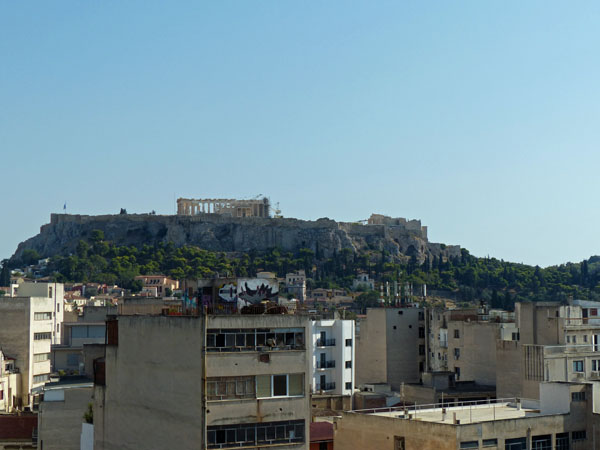
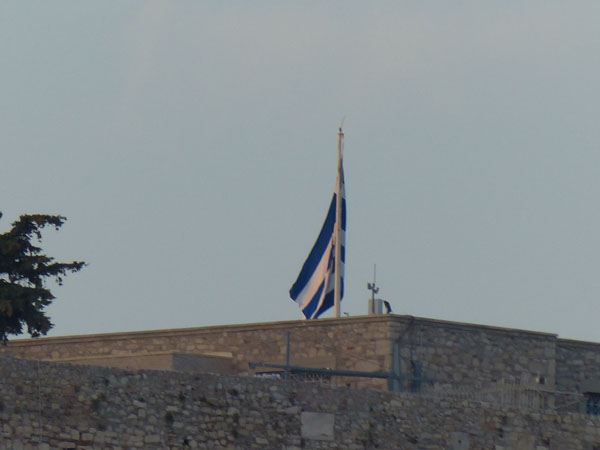
I mentioned earlier, I have a mild case of acrophobia. Heights (like balconies) tend to make me nervous. ‘Acrophobia’ comes from the Greek ἄκρον (height) and φόβος (fear) – i.e., fear of height. The “acro’ part of ‘Acropolis;’ the πολις part is the word for ‘city’ (as in ‘metropolis). So the Ακρόπολις is literally, ‘High City.’ It is on a high hill which may have served as a defensible fortress for the early Athenians, and also was a ‘high place’ where the ‘high gods,’ especially Athena, were worshipped. The picture is viewing from the north. On the far right there is a slope which was used to access the top of the Acropolis. At the top of this slope are a group of buildings and temples that served as the gateway to the flat summit of the Acropolis. The Parthenon is the main building on the summit today. It is, by the way, not a temple. Never was. It is a ‘memorial’ celebrating the victory of Athens over the Persians at Thermopylae. In that war the Temple to Athena was destroyed and never rebuilt. The foundations are all that is left and the ground was regarded as sacred. The other curious thing is that you approach the Parthenon from its back, not its front, which faces that very steep cliff on the east where a Greek flag flies today.

Greek Flag
Greek Flag on the Acropolis

There is a story behind that flag. It was there when the Nazi’s took over Athens. A Greek soldier was ordered to take down the Greek flag and raise the Nazi flag. The soldier took down the Greek flag, wrapped himself in it, and then jump off that cliff to his death. It was the beginning of the Greek resistance to the Nazis.

Today’s photo Journal is at my website.

Canicus Modius

Canicus in Athens: Day 1 (10 Sept 2013)

I was up at 3:30 AM Monday in Dallas to shower, shave, and otherwise make the absolute last packing for the trip. The Super Shuttle requested I be ready 15 minutes before the scheduled pickup time. As it turned out the shuttle was 30 minutes late.

The flight to Denver (I know, this made no sense) was on an Air Canada Airbus 320. While not quite the sardine can the last time I flew American Airways or US Air, the economy seats are not designed for someone who is 6’1” and has long legs. Nor will the drop down tray work with my thighs.

When I got to Montreal we went to a room where there were at least a thousand people lined up for customs and immigration. Yes, we had to go through immigration and to fill out a customs declaration – even though we were simply changing planes. They did have a shorter, faster line for those of us with connecting flights. Then there was one of those electronic boards that informed me my plane was leaving from gate 61. Of course then there were no signs pointing to gates more than about 54. So I headed toward the ascending numbers. Wrong – 61 was the other direction.

The flight to Montreal was on an Air Canada Airbus 319. (I don’t have any idea how these numbers work). It was far more accommodating. I got selected to be in the last group to load. Before our group was allowed to load it was announced there was no more room for carryon luggage and it would have to be checked. I played deaf (not hard for me) and didn’t check my backpack. There was plenty of room for it in the overhead bins, but not just near my seat.

The flight to Athens was on an Air Canada Rouge Boeing 767/300. Sardine time. Not only were the seats too close together and the tray too close to the seat for a guy my size, but there were vent boxes under each aisle seat, which meant that only my left leg/foot could extend under the seat in front of me. More fun – there apparently was a problem with the planes maintenance log (or so the pilot informed us) that took an hour to resolve before we were cleared for takeoff. We were rewarded with free earphones.

So on Tuesday I arrived in Athens an hour later than planned. No real problem as the ‘check in time’ for the hotel was 2 PM. I decided to take a taxi to the hotel. That eliminated the hassle of subways and changing subways and a walk from the subway to the hotel with my baggage.  Good move; the walk would have been uphill.

When I went to the hotel desk they said they had a problem with the reservations system. They were putting me in another hotel for one night. They provided taxi fare to and from that hotel, coffee and scones while I waited for the taxi. This one night hotel is quite modern. It has one of those neat key card things that unlocks the door, turns on the electricity (and air-conditioning) and opens a safe in the room. My sixth floor room (actually seventh floor because in Europe C programmers number floors, with the ground floor being 0) has a balcony with table and chairs and a view of the Acropolis and Parthenon.

Taxis in Athens are yellow. The drivers are insane. The taxi driver from the airport to my first hotel insisted on look at me and talking has he zoomed down the toll road from the airport to the city and in the city dodged cars and motorcycles in very congested traffic. Some streets are very narrow; and the wide one are rendered narrow by double, triple and even quadruple parking. The driver of the second cab from the first to the second hotel talked on his cell phone as he dodged motorcycles, bicycles, pedestrians, cars, trucks, buses and street cars. I have concluded I need to be very attentive while walking – looking especially for yellow taxis and motorcycles.

Tomorrow I’ll shower, shave and have breakfast at this hotel and the transfer to the other hotel. I had planned on taking a stroll around the Acropolis (not climbing it). But I noticed one of those double decker tour buses – so I may try to find one and take the tour. I’ve learned from Paris and Rome that is a good way to get oriented to the cities.

The photo journal for today is at Canicus Modius in Greece – 10 September 2013 – Athens

Canicus Modius

Prelude to Athens

Rome may be the ‘Eternal City’ but Athens has been around longer. According to tradition the city of Rome was founded in 753 BC. Archeologists have found remains indicating that the Palatine hill was occupied around that time, making the city around 2,700 years old. There is some evidence of earlier occupation, but the clear evidence of a permanent existence would seem to support the mid-eight century founding and the beginning of continual occupation down to the present.

However, Athens seems to have been occupied for 7,000 years. It was an important Mycenaean city in the 15th century BC. There are traces of that era found on the Acropolis. When Rome was founded, Athens was a major Mediterranean power and had colonies on the eastern coast of the Mediterranean and in the Italian peninsula.

The Roman Republic traditionally began in 509 BC with the overthrow of the monarchy. Nearly a century earlier Solon had given the city a constitution and laws which would provide a foundation for later democracy. In 510 BC Cleisthenes was establishing a democracy in Athens. The Persian King Darius angry over the Athenian colonization of the western coast of Asia invaded Greece but was repelled in 490 BC when the Athenians defeated his army at Marathon.

The great classical period of Athens was from 508 to 322 BC. This was the era of Pericles, Socrates, Plato, Sophocles, Euripides etc. that we associate with ancient Athens. Athens was the dominant Mediterranean economic and naval power of the time. Meanwhile Rome was slowly extending its power over the surrounding areas of the Italian peninsula. Rome had yet to fight the Carthaginians in the Punic Wars (264 BC to 146 BC) establishing its dominance over the Italian peninsula, Sicily, northern Africa and Spain and beginning involvement in Greece and Asia.

Athens is named after the goddess of wisdom and war, Athena, who, according to the tradition, sprang full grown from the head of Zeus. Homer consistently calls her ‘owl-eyed Athena’ and she was consistently associated with an owl. The ‘Athenian owl’ was a silver coin widely used in commerce when Athens ruled the seas. The obverse of the coin showed the helmeted head of Athena and the reverse an owl. The reverse also featured an olive branch, olives being is major agricultural product which was (and still is) greatly prized among connoisseurs of olives and olive oil. The coins also featured a waning moon – a political dig at the rival Sparta. When Darius had invaded Greece, Athens had sent to Sparta for aid in repelling the invasion. But Sparta declined because the moon was waning and they could not religiously fight until the new moon. Athens stopped the invasion at Marathon without Spartan help.

I do not anticipate blogging on Monday. I’ll be in airports and on planes. I may tweet (@canicusmodius) if I find free Wi-Fi for my smartphone. My laptop will be in my carryon, but I don’t anticipate using it.

P.S. The graphic I am using is not in Greece, it is in Italy. It is, however, a Greek temple dedicated to Poseidon located in the Greek colony of Paestum. I took the picture last summer when I visited.

Canicus Modius